

There exists an infinitely large two-dimensional grid of uncolored unit cells. You are given a positive integer n, indicating that you must do the following routine for n minutes:
- At the first minute, color any arbitrary unit cell blue.
- Every minute thereafter, color blue every uncolored cell that touches a blue cell. Below is a pictorial representation of the state of the grid after minutes 1, 2, and 3.
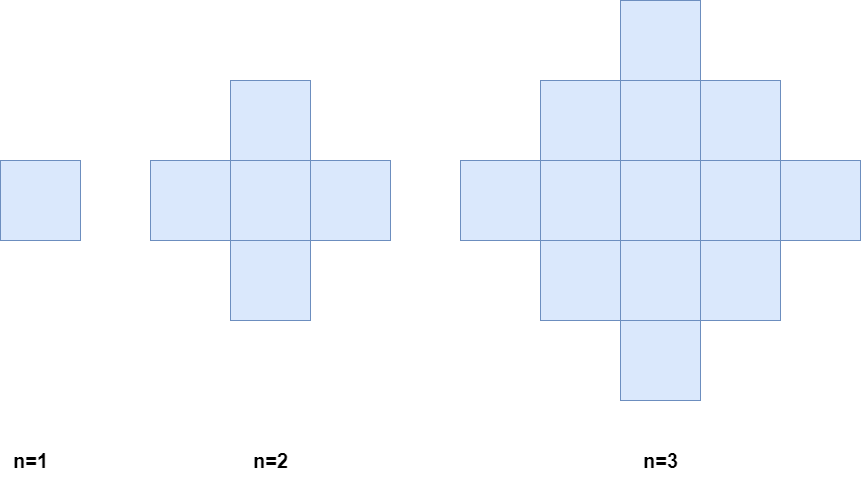
Return the number of colored cells at the end of n minutes.
Constraints:
1 <= n <= 10⁵
Below is a detailed explanation following the requested format:
Approach: Mathematical Formula
func coloredCells(n int) int64 {
    return int64(2*n*(n-1) + 1)
}The idea is to recognize that the process of coloring cells creates a symmetric pattern. Starting from a single blue cell, every minute the “frontier” expands outward. When you analyze the pattern, you’ll see that the number of colored cells after n minutes is equivalent to the sum of two squares: one for the cells added in the current minute and one for the “previous” expansion. This can be mathematically derived as:
Total = n² + (n-1)²This expression simplifies to:
Total = 2n² - 2n + 1 = 2 x n x (n - 1) + 1Thus, the solution can be computed in constant time using simple arithmetic.
Intuition
-
Expansion Pattern:
- At minute 1, there is 1 blue cell.
- In subsequent minutes, all cells adjacent (touching) any blue cell are colored. This creates a pattern that grows outward in all directions.
-
Observing the Odd Sequence:
- The number of colored cells along the “middle” row follows an odd number sequence: 1, 3, 5, …, up to 2n-1.
- The sum of the first n odd numbers is n².
- The remaining part of the pattern (which is symmetric) contributes (n-1)².
-
Combining the Two Parts:
- Adding these two parts together gives the total number of colored cells:
n² + (n-1)²This insight reveals why a simple mathematical formula works to solve the problem in constant time.
Algorithm
-
Input:
Receive the integer n which represents the number of minutes. -
Compute the Two Squares:
- Calculate n² for one half of the pattern.
- Calculate (n-1)² for the other half.
-
Sum the Results:
- The total number of colored cells is n² + (n-1)².
-
Return the Result:
- Since the result can be large, cast it to an appropriate integer type (e.g.,
int64in Go).
- Since the result can be large, cast it to an appropriate integer type (e.g.,
Complexity Analysis
-
Time Complexity:
O(1)- The solution only involves a fixed number of arithmetic operations, regardless of the input size. -
Space Complexity:
O(1)- Only a few variables are used for the calculations, so the space used does not grow with the input.
Wrap up
If you found this guide helpful, consider subscribing to my newsletter on jyotirmoy.dev/blogs , You can also follow me on Twitter jyotirmoydotdev for updates and more content.